Hedera set out as a public network run by named institutions, fast and cheap enough for serious use. It still runs that way. The money that would prove serious use has moved the other way, and the token has followed it. The records describe a working chain whose appeal has narrowed to governance and low cost.
The market numbers come from CoinGecko, read on 15 November 2026, while locked value, fees and exchange trading come from DefiLlama. On-chain pool data comes from GeckoTerminal, the public code record from GitHub, and earlier versions of the website from the Internet Archive.
Council control and a fixed low fee
Hedera presents itself as a network controlled by named institutions rather than anonymous operators. CoinGecko lists Google, IBM, Boeing and Deutsche Telekom among the council members, alongside other global companies. Hedera puts the point directly: "network nodes are run by the Hedera Council". Trust rests on those names, not on open participation.
The price of using the network follows the same fixed pattern. Hedera states: "Fees are set in USD starting at $0.0001". Each charge converts to HBAR at payment, so the dollar amount holds steady when the token moves. HBAR covers transfers, smart contracts and data storage. Staking pays for tying the token to a node, in Hedera's words: "Earn rewards by staking HBAR to a network node." Documentation describes the production network in plain terms: real HBAR, real fees, real users. Disputes go to binding arbitration for one person at a time, not to a jury trial or a class action.
A visitor faces no demand for money on the home page. Of 96 labelled links there, none asks a visitor to deposit, lock, stake, buy or pay. A link to staking appears on 1 of 7 app pages read. Hedera presents HashPack as its main wallet, in its words: "HashPack is the leading non-custodial wallet serving as the primary gateway to Hedera’s ecosystem." The page sells access, not a return.
Money left the applications while fees stayed tiny
Value locked counts money deposited in applications on a network. DefiLlama puts Hedera's figure at about $20.00 million on 14 November 2026. Twelve months earlier the figure stood at about $84.62 million. That is a fall of -76.4%.
- Binance14.815%
- Coinbase Exchange13.313%
- WhiteBIT1313%
- BTCC6.706.7%
- OKX5.505.5%
- Other venues46.647%
Fees beside that figure look small. Users paid about $14,400 in fees in the last 30 days and about $267,000 over one year. Trading through exchanges on the network reached about $51.23 million in the last 30 days and about $814,000 in the last 24 hours. Revenue here means money the project itself records as earned, distinct from fees users pay to use the network. No revenue figure for the project appears in that source, so the share reaching token holders cannot be checked there. The source lists only revenue, investors and incidents that are publicly documented, so a blank entry means nothing was documented there.
Tokenized property claims lack outside confirmation
The current website centres on tokenization, putting ownership of a real asset on a chain. Hedera says it and Archax completed trades described as: "UK’s first foreign exchange (FX) trades using tokenized real-world assets (RWAs) as collateral". Hedera presents the work as a landmark for collateral efficiency and regulatory compliance. It also says a partner uses the network to tokenize "over $5 billion worth of institutional-grade properties". Hedera also describes a toolkit for regulatory-compliant issuance of tokenized securities on-chain. No announcement from a partner sits beside those statements, so both stay as Hedera's claims.
| Check | Reading | Signal |
|---|---|---|
| Price against its peak | −90.1% | Warning |
| Largest venue share of trading | Binance 14.8% | No warning |
| Supply not yet circulating | 11.3% | No warning |
| Public code | Updated in the last 90 days | No warning |
| Revenue in the last 30 days | Not tracked | No data |
| Security incidents recorded | 1 | Warning |
| Value locked against a year ago | -76.4% | Warning |
A capture from 2 November 2025 made a stronger identity claim. Hedera called itself: "As the world’s only public network governed by known institutions". It also said its native services reach 10,000 TPS and beyond, with TPS meaning transactions per second. The pitch has kept its direction: institutions, compliance and scale.
HBAR trades far below its peak, mostly off-chain
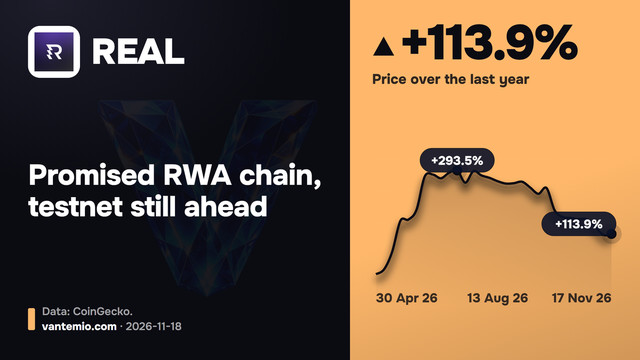
CoinGecko's reading puts HBAR at $0.05626. The all-time high was $0.5692 on 15 September 2021, leaving the price -90.1% below that peak. The all-time low was $0.009861. Market value, price times tokens in circulation, was about $2.49 billion, good for rank 36 by market value. CoinGecko lists it under Smart Contract Platform and Layer 1 (L1). Fully diluted value, price times the maximum supply, was about $2.81 billion.
The gap between those two values comes from supply. Circulation totalled 44.33 billion tokens, while total and maximum supply each stood at 50.00 billion. Tokens outside circulation were 11.3% of the maximum supply. The price dropped -33.9% over 30 days and -63.2% over one year. Volume in the last 24 hours was about $84.84 million, equal to 3.4% of market value.
Almost all trading happened on centralised venues. Binance handled about $12.59 million, or 14.8% of the total. Coinbase Exchange handled about $11.28 million, 13.3%, and WhiteBIT handled about $11.07 million, 13.0%. BTCC handled about $5.67 million, 6.7%, OKX handled about $4.70 million, 5.5%, and Toobit handled about $4.11 million, 4.8%. Centralised venues accounted for 100.0% of reported volume, while on-chain pools accounted for 0.0%. Those pools trade on the network itself. Holder concentration, the share held by a few wallets, is not measured here because HBAR is the native coin of its own network and has no token contract.
Active code, one incident, and the verdict
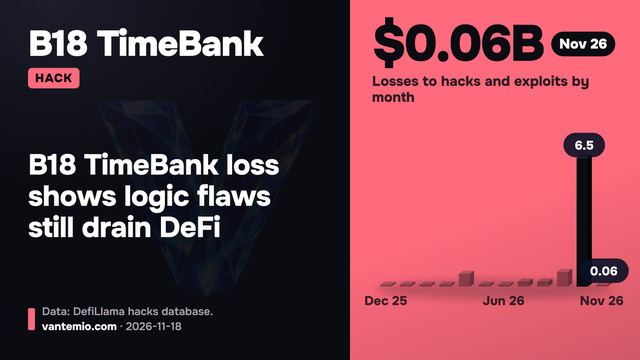
The public code record shows continued work. The GitHub account hashgraph holds 93 public repositories, 86 of them its own, with 1,803 stars in total. The most recently updated repository is guardian, on 14 November 2026. DefiLlama's hacks database lists one incident for the project, about $600,000 taken under Access Control. One recorded incident is a single entry, not a pattern in this record.
What keeps such a network going stays open in these records. User fees are small and locked money has fallen, while council governance and low fees are documented. Growing use is absent from the figures.
Hedera remains a functioning chain run by named institutions, with costs a user can predict and code that changes. The records show no return of the money that left, and no fee base that would replace it. Anyone holding the token holds that split: governance and cheap transactions on one side, shrinking use on the other.<p data-vantemio-partner-disclosure="v1"><em>Disclosure: links to Coinbase on Vantemio are partner links.</em></p>
Source: CoinGecko, GitHub, hashgraph, DefiLlama, Hedera, website, Hedera, app · Date: