Token holders in two crypto organisations used votes to change how money moves in their systems, and both decisions passed with almost no opposition. Uniswap holders backed an upgrade to a fee mechanism that adjusts charges as prices move, while ENS holders agreed to let their endowment use a limited options technique during planned shifts between ether and stablecoins. The votes show governance working as maintenance, tuning a trading tool on one side and widening a treasury rule on the other, with execution to come.
Snapshot, the voting service used by large token-holder groups, recorded the two decisions in votes that closed in the period ending 21 November 2026. A DAO is a group governed by holders of its tokens, who vote on written proposals. Voting power is the weight carried by the tokens behind each vote, and a quorum is the minimum amount of that weight needed for a result to count. Both votes ask a practical question: whether small technical changes to fees and treasury rules can protect liquidity providers and funds held for a project, without handing new discretion to managers or developers.
How the Uniswap fee hook is meant to work
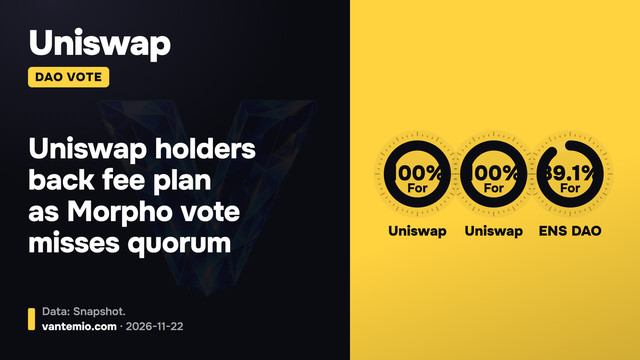
The Uniswap proposal covers a hook for volatile pairs in Uniswap v4, a dynamic-fee tool built by Uniswap Labs, and an update to the protocol fee releaser on X Layer. It closed on 20 November 2026 with 131 voters and 12.92 million votes of voting power behind it. Support reached 100.0%, and the quorum of 10.00 million was reached. The result was unanimous on the figures recorded, which makes the mechanism itself, rather than any dispute over it, the story.
The hook went live on Ethereum on October 14 with the ETH/USDC pool and has since launched on Robinhood Chain with the ETH/USDG pool. Volatile pairs did more than $500 billion in volume on Uniswap this year, according to the proposal text. In a static-fee pool, a price move elsewhere leaves liquidity providers absorbing the cost while the pool quotes a stale price and another trader profits from the gap. The hook prices both sides of a trade, setting separate buy and sell fees on every swap. When the pool price rises, buying costs more and selling costs less. When the pool price falls, the fees flip. After a large price move, trades that push the price back pay a temporary fee. The design aims to keep value in the pool while quoting a competitive spread, supporting stronger and more consistent returns for liquidity providers. The hook is an upgradeable proxy contract owned by Uniswap Governance, so governance retains control over later changes to the mechanism.
What the ENS endowment change permits
The ENS DAO proposal, numbered 7.4, amends the Endowment Investment Policy Statement, known as IPS v2.0 under EP 6.46, to permit covered options writing as part of scheduled rebalancing by the Endowment. It closed with 36 voters and 1.33 million votes of voting power. Support reached 95.4%, with 3.8% abstaining and 0.8% against. The change relaxes a single existing constraint: options written in the direction of a required rebalance are treated as ETH and stablecoin rebalancing under Section 5, rather than as speculative trading. No other constraint is relaxed, and the Minimum Runway and its priority are unchanged.
| DAO | Proposal | Result | Voters |
|---|---|---|---|
| Uniswap | Upgrade VolatilePair hook and update X Layer Releaser | For 100% | 131 |
| ENS DAO | [7.4] [Social] IPS Amendment No. 1: Endowment Options Overlay | For 95% | 36 |
The Endowment rebalances between ETH and stablecoins on the schedule in Section 7 and executes every rebalance at spot. KPK, the manager named in the proposal, proposes executing part of that flow through covered options. The methodology, backtest and rationale for each limit are set out in a document called Expanding the Endowment Mandate: Onchain Options, and the discussion there, together with the amendment thread, forms the written rationale under Section 3. An update on 10 November was part of that discussion on the governance forum. This vote is a policy change only. It grants no onchain permissions. Permissions for the Endowment Manager on any options venue would be granted separately through a Permissions Update Request, reviewed by Blockful and moved to execution at the discretion of the ENS Foundation Board. If the proposal passes, the consolidated text will be published as IPS v2.1, pinned to IPFS and shared on the governance forum for record keeping.
Why unanimity is not the same as low stakes
Both results look routine because the margins are wide, yet the subjects are not trivial. A fee mechanism decides who bears the cost when prices move fast, and a treasury policy decides how much risk a project accepts with money set aside for its future. The Uniswap change touches traders and liquidity providers on every swap in the affected pools, while the ENS change touches the balance between ether and stablecoins held for the long term.
A competing reading is that unanimity reflects careful bounding rather than indifference. The hook was already live, the upgrade sits inside a contract owned by governance, and the ENS amendment keeps every other limit in place while confining the new technique to rebalancing already scheduled. That framing gives holders a reason to agree without endorsing open-ended trading. The risk in that reading is complacency: a bounded tool can still be used badly in execution, and a policy that permits a technique does not by itself show that the technique will be used well. Snapshot records what token holders chose; whether and when a decision is carried out on-chain is up to the DAO and its executors, and the proposal text gives the reasons given by the proposers, which are theirs.
Execution will decide whether the votes matter
The useful test after the votes is execution rather than the vote count. Watch whether Uniswap Governance carries the hook upgrade through on Ethereum and updates the releaser on X Layer, and whether the fee behaviour described in the proposal appears in the pools it covers. Watch whether ENS publishes the consolidated policy text, pinned to IPFS and shared on the governance forum, and whether a separate permissions request for an options venue appears, with review by Blockful and a decision by the ENS Foundation Board. Those steps would turn a recorded choice into an operating change.
The verdict from this reading is narrow and positive: holders used two votes to tune a market mechanism and to widen a treasury rule within stated limits, instead of granting new powers or settling an emergency. That is a useful form of governance when the limits hold in practice. If execution follows the terms set out in the proposals, liquidity providers should see fees respond to price moves and the ENS Endowment should rebalance with a new tool inside its existing schedule. If execution stalls, the votes will stand as intentions rather than changes.
Source: Snapshot, Snapshot, ENS DAO, [7.4] [Social] IPS Amendment No. 1: Endowment Options Overlay · Date: