Participation, not approval, decided this round of DAO votes: Uniswap holders backed two linked changes that would put one fee system across every chain where the exchange already charges, while a unanimous Morpho vote still failed to clear its quorum. The decisions were recorded on Snapshot, the voting service used by the organisations in this reading, with the Uniswap and ENS DAO votes closing on 21 November 2026 and the Morpho vote closing a day later.
A decentralised autonomous organisation, or DAO, lets token holders vote on written proposals. Voting power is the weight carried by those tokens, and a quorum is the minimum voting power that must take part for a result to count. That distinction decides this set of results: support alone was enough for Uniswap and ENS DAO, but not for Morpho, where participation fell short even though every vote cast was in favour.
One fee system for every fee-active chain
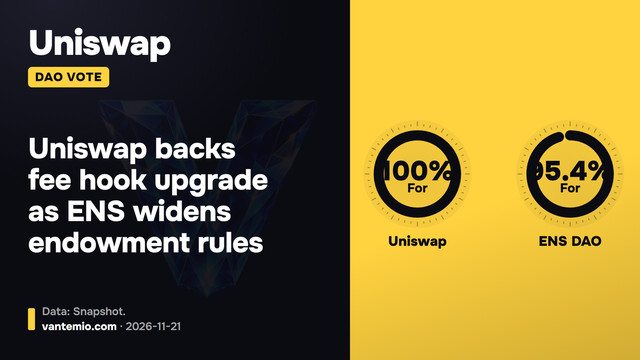
The larger Uniswap proposal, Protocol Fee Expansion: v4 on Five More Chains, drew 136 voters and 27.92 million votes of voting power. It passed with 100.0% in favour, against a quorum of 10.00 million that was reached. The proposal would extend v4 protocol fees to five more networks — Celo, Soneium, X Layer, World Chain and Zora — the last ones still using only the earlier v2 and v3 fee setup.
Fees are already active under v4 on eight chains, after v4 protocol fees went live in July. Bringing the remaining chains onto the same system removes a split in how the protocol charges across its own markets. For a holder of UNI, the practical point is uniformity: fees route to the TokenJar on each chain, and the proposal says the TokenJar and its releaser setup are already in place on each of the five, from the earlier v2 and v3 activations, so no new burn path is required.
The same proposal also cuts the target LP fee for Arbitrum's two USDC/USDG StablePair pools. LP, or liquidity provider, fees are paid by traders to the people who supply the assets in a pool. The excerpt gives the direction of that change but not the new level, so the size of the saving for traders in those pools, and the cost to providers, cannot be judged from this reading alone.
A new adapter built for hooks Uniswap does not control
A second Uniswap proposal, Upgrade the v4 Protocol Fee Adapter, attracted 135 voters, with voting power matching the first proposal. Support was again unanimous, and quorum was met. It would replace the V4FeeAdapter's V4FeePolicy across the eight chains with live v4 protocol fees, while leaving current fee levels unchanged for pools already paying.
| DAO | Proposal | Result | Voters |
|---|---|---|---|
| Uniswap | Protocol Fee Expansion: v4 on Five More Chains | For 100% | 136 |
| Uniswap | Upgrade the v4 Protocol Fee Adapter | For 100% | 135 |
| ENS DAO | [7.5] [Social] IPS Amendment No. 2: IPS Amendment Authority | For 89% | 38 |
| Morpho | MIP 136 – List MidnightAdapter in Morpho Registry | For 100% | 15 |
Hooks let builders launch new pools with custom behaviour, and the proposal text says they vary widely: some rely on static LP fees, others on dynamic fees, and others on custom accounting for swaps. The initial protocol fee controller, the proposal argues, lacks the expressivity required for all those types. The upgraded logic would let governance set fees for any hook through flexible and reusable rules, and would give hooks a direct way to opt into the protocol fee themselves.
The upgrade opts in pools using Uniswap Labs-owned hooks, and does not enable the protocol fee on any third-party developed hooks. For builders, that preserves a choice: a third-party hook is not brought into the fee system by these votes. For Uniswap, it leaves a gap between the technical ability to set fees for any hook and the political decision to apply them only where the hook owner has opted in or where Uniswap Labs owns the hook.
Both Uniswap proposals use the expedited governance process approved in UNIfication, under which proposals to update fee parameters skip the RFC stage and move straight to a five-day Snapshot and then an onchain vote. A Snapshot result records what holders chose; the DAO and its executors decide if and when to carry it out on-chain. Readers should therefore treat these as approved directions, with the onchain step still to come, rather than as fees already changed on the five new chains.
ENS moves policy power to its foundation board
ENS DAO took a different kind of decision, about who may change a policy rather than about fees. Its proposal, [7.5] [Social] IPS Amendment No. 2: IPS Amendment Authority, saw 38 voters take part, representing 1.13 million in voting power. The result was divided — 89.1% in favour, 10.5% against and 0.4% abstaining — the only split vote in this reading.
The Investment Policy Statement, or IPS, sets the mandate for the ENS Endowment and its manager. Under IPS v2.0, adopted as EP 6.46, only a DAO vote could change the policy and MetaGov was named as the oversight body. The amendment would let the Foundation Board amend the IPS by resolution after a 7-day forum discussion, at its reserved-matter threshold of four of five Directors. The Foundation would replace the Meta-Governance Working Group as oversight body and as counterparty to the Endowment Manager.
The proposal links that change to Next Era of ENS DAO: Empowering the ENS Foundation, executed on 11 August 2026, which delegated the Endowment and the manager relationship to Foundation governance and made the Foundation timelock the owner of the Endowment Safe. On that account, the board already holds the Safe and the manager relationship, while the policy still pointed at MetaGov and still required a Snapshot for every change to strategy or allocation. The amendment aligns the document with that earlier delegation.
Two safeguards are written into the text. The DAO keeps the Minimum Runway and sole authority over Section 3 changes, so the Foundation cannot rewrite the amendment process or its own role, and the DAO can reverse any Board amendment by Social Proposal. The trade-off is speed against direct control: routine policy changes would no longer need a full token vote, but reversal would require holders to organise one after the fact. The 10.5% against is a reminder that this transfer was contested in a way the Uniswap fee votes were not.
Unanimous, but not enough to count
Morpho's MIP 136 – List MidnightAdapter in Morpho Registry closed on 22 November 2026 with 15 voters and 254,000 votes of voting power. Every vote was in favour, yet the quorum was 500,000 and was not reached. The proposal would list the MidnightAdapter in the Morpho Registry, conditional on completion of its security reviews and integration of all resulting fixes.
That result is the clearest lesson in the reading for anyone who follows DAO votes by headline percentages. A figure of 100.0% describes only the votes cast. It does not describe participation, and participation is what quorum measures. Morpho holders who took part agreed, but too little voting power took part for the decision to count under the stated threshold, so the listing cannot proceed on this vote alone.
The four decisions show three different states of governance. Uniswap has unanimous support, quorum and a defined onchain next step for a fee system that would then cover every fee-active chain named in its proposals. ENS DAO has a majority decision that shifts day-to-day policy authority to a five-person board while keeping a DAO reversal route. Morpho has agreement without the participation its own rules require. The next readings to watch are the Uniswap onchain votes that follow the Snapshot stage, any first use by the ENS Foundation Board of the new amendment power, and whether Morpho returns the MidnightAdapter listing to voters with enough participation to reach quorum.
Source: Snapshot, Snapshot, Uniswap, Upgrade the v4 Protocol Fee Adapter, ENS DAO, [7.5] [Social] IPS Amendment No. 2: IPS Amendment Authority, Morpho, MIP 136 – List MidnightAdapter in Morpho Registry · Date: