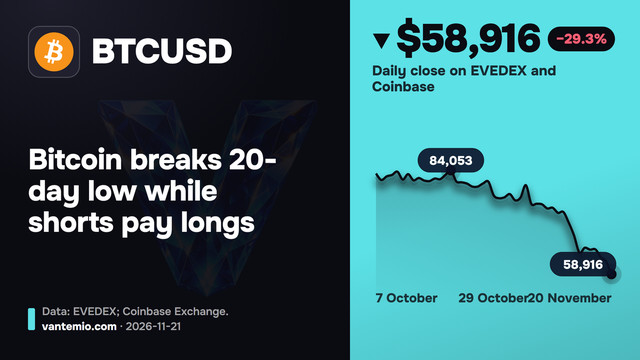
The twenty-day range that had contained Bitcoin is gone. EVEDEX recorded a close beneath its lowest point in that span, while the payment between traders still ran from those betting on further falls to those waiting for a rise. That combination leaves holders without a recent floor and puts the burden on buyers: a climb back above the old low is now the only close that would undo the break.
That is new since the previous reading in this series, which described Bitcoin holding just above the bottom of its recent range, not falling through it. EVEDEX published the figures the following day, with the last closed daily candle dated 19 November 2026. That timing turns a warning into a recorded move, because the floor that had contained trading for twenty days did not hold into the close. A test of support leaves room for a rebound from a known level, while a close beneath it leaves the market searching for the next level that buyers will defend.
The floor gives way
On EVEDEX, the close was $61,955, below the twenty-day low of $62,018. The previous day had closed at $63,037, a fall of 1.7% in a single session. That one-day move looks small beside the longer slide, yet it carried the price through a level that had marked the bottom of recent trading.
Seven days earlier the close stood at $71,423, and the latest close sits 13.3% below it. Thirty days earlier it stood at $82,989. The highest price in the twenty days before the break was $81,188, so the distance from the top of the range to the break is wide enough to describe the move as a change of range rather than a brief dip below it.
The payment that rewards waiting for a rise
A perpetual contract has no expiry date, so traders can keep a position open and use borrowed money to enlarge it. EVEDEX allows leverage of up to 200 times, which means small price moves can produce large gains or losses for a leveraged trader. All positions still open were worth $845 million, while trading over twenty-four hours reached $515 million. Those two figures describe a market that remains active even as the price falls, rather than one that has gone quiet.
| Level | Price | Distance from last close |
|---|---|---|
| Last close | $61,955 | — |
| 20-day high | $81,188 | +31.0% |
| 20-day low | $62,018 | +0.1% |
| 20-day average | $71,989 | +16.2% |
| Average daily range | $2,652 | 4.3% |
The funding rate was -0.0321% per 8 hours, which means holders of short positions pay holders of long positions. Such a payment usually signals that short positions dominate, because it is designed to pull the contract back toward the price of Bitcoin itself. That session also ended 13.9% below the twenty-day average close of $71,989, so the break sits well away from the centre of recent trading rather than just below its edge.
An independent market tells the same story
On the independent spot market, Coinbase Exchange closed Bitcoin at $61,913, a difference of +0.1% against the EVEDEX close. The closeness of the two closes matters because the two venues trade different instruments: one trades Bitcoin itself, the other trades a contract on its price. When both settle near the same level after a break, the move looks less like a quirk of one order book and more like a market-wide repricing.
Over thirty days, Coinbase shows a fall of 25.4%, against a fall of 25.3% on EVEDEX. The near-identical thirty-day moves reinforce the point: the break was not confined to derivatives trading. It appeared in the spot market too, where buyers and sellers exchange Bitcoin itself.
At 01:00 UTC trading reached $52.7 million, the heaviest hour of the day, while prices moved between $61,401 and $64,058. Over 14 days, the typical daily swing from high to low averaged $2,652, equal to 4.3% of the price, so a move of the size seen in the latest session fits the recent pattern of wide daily swings rather than standing out as an isolated jump.
The test that comes next
For a holder, the practical change is the loss of a reference point. That old low can now be tested from below, and a return above it would be the first sign that the break has failed. Until that happens, the market has no recent floor to point to, and the negative funding payment gives traders who are short a reason to keep paying for the position rather than closing it in a hurry.
EVEDEX publishes only its own contract data, and Coinbase covers spot trading, so neither venue shows the whole market, and the figures here cover a single closed day. This piece draws on public market data and is research, not a recommendation to trade. Leveraged trading can produce losses larger than a trader expects, and earlier prices offer no promise about later ones. Vantemio has a commercial partnership with EVEDEX.
The next test is simple to state and hard to pass. Bitcoin must reclaim the level it has just lost, and it must do so while the payment between longs and shorts stops rewarding the side that expects further falls. If the price stays below its old floor and shorts keep paying longs, the break will have done more than mark a bad day. The range that contained the past twenty days is left behind.<p data-vantemio-partner-disclosure="v1"><em>Disclosure: EVEDEX is a Vantemio partner exchange. Through the EVEDEX API, Vantemio links that exchange to its trading terminal and receives part of the trading fee. Links to Coinbase on Vantemio are partner links.</em></p>
Source: EVEDEX, Coinbase Exchange, BTC-USD · Date: